
Hollywood got one of the sweetest and most eyebrow-raising surprises of the awards season. The 15-year-old actor Owen Cooper, already making headlines as the youngest male ever nominated at the Emmy Awards for Outstanding Supporting Actor in a Limited Series or Movie, got more than just a shot at glory.
He got a gift from his idol. In a move nobody saw coming, Jake Gyllenhaal walked into a pre-Emmys interview room and handed Cooper a small golden duck, a “lucky duck” meant to bring him good luck at the big night.

Cooper was filming in his hotel suite, talking about his hopes, when the door opened and Gyllenhaal appeared, walking down the hallway, nervous and grinning like a schoolkid who snuck candy. “I have a present for you,” Gyllenhaal said, holding out the duck. “I got this before one of my own big nominations. Thought you could use a little luck.”
Cooper froze. His jaw dropped. All he could manage was “Oh my God.” Inside that little box was a symbol; hope, respect, perhaps a funny jab at superstition. But more than that, it was a message: you belong.
Fans watching online went wild. Some said it was adorable, others called it the best bit of the Emmys 2025. But some sharp critics raised eyebrows: Is this real mentorship or just clever PR?
The idea that an Oscar-nominated actor would personally boost a teenage fan’s morale sounds like a feel-good fairytale. But in an industry where hype sells more than talent sometimes, a golden duck might just be the perfect prop for a viral moment.
Still, the night belonged to Cooper. With the duck tucked in his pocket, he went on stage and clinched the Emmy, making history as the youngest male winner ever in his category. People cheered. Streaming numbers for the series “Adolescence” exploded.
The “lucky duck” became a meme, a symbol of youth, raw talent, and maybe a little bit of magic.
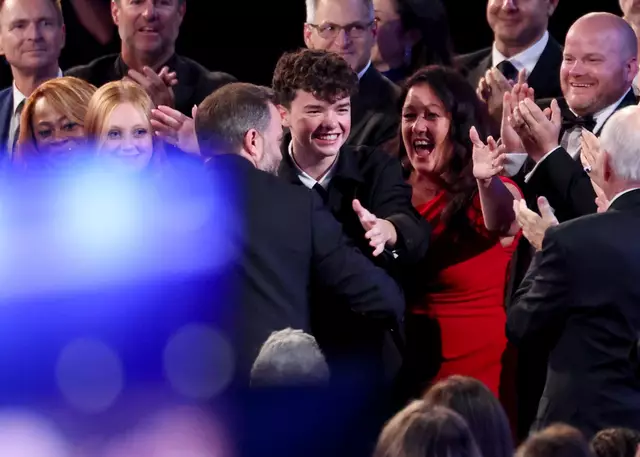
Backstage, some whispered that Gyllenhaal’s gift might have swayed the energy in the room. Others wondered if it was all orchestrated; a veteran actor fluffing up a rookie just before votes were counted.
Rumors swirled that producers loved the narrative: a young unknown wins big, gets blessed by a legend, and becomes an overnight sensation. Could this have been staged? Maybe. But the raw emotion on Cooper’s face felt real.
What’s more, the duck isn’t just a duck now.
It symbolizes a shaky balance between fandom and opportunity, innocence and ambition. For Cooper, it was a charm, a trophy of sorts before the trophy even landed. For Gyllenhaal, it was an image of generosity, mentorship, or savvy self-promotion. For the industry, it was a reminder that in entertainment, illusions are often packaged as heartfelt moments. And yes, sometimes you need a golden duck to survive the madness.
So now, months later, people still talk about that moment.
The clip going around online with Cooper sobbing “Oh my God.” The headlines: “Youngest Emmy Winner Gets Golden Duck from His Hero.” The memes. The merchandise. It all begs the question: in a world where attention is as powerful as talent, was that duck a lucky charm or the perfect publicity stunt?
One thing’s certain: for Owen Cooper, the duck won’t ever leave his pocket. It might just remind him that sometimes in Hollywood, magic comes rubbery, shiny, and quacking.